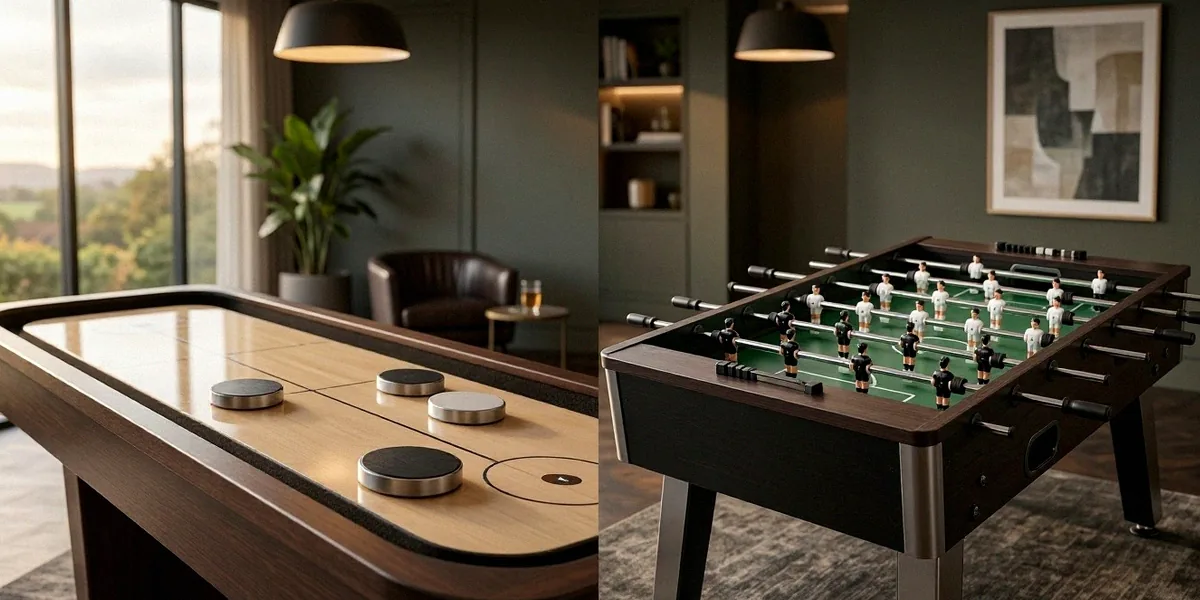
Shuffleboard vs Table Football: Which Suits Your Games Room?
Every few months, one of us gets the itch to finally sort out the spare room. You know the one — the box room that currently holds a broken exercise bike, three half-used tins of paint, and a lamp with no shade. The dream is always the same: clear it out, stick a proper games table in there, and become the house where everyone wants to watch the football and stay for a few beers. And every single time, the shortlist comes down to two names. Shuffleboard or table football. It’s the great British games room dilemma, and we’ve argued about it over more pints than we care to admit.
The Contenders: A Quick History and Appeal
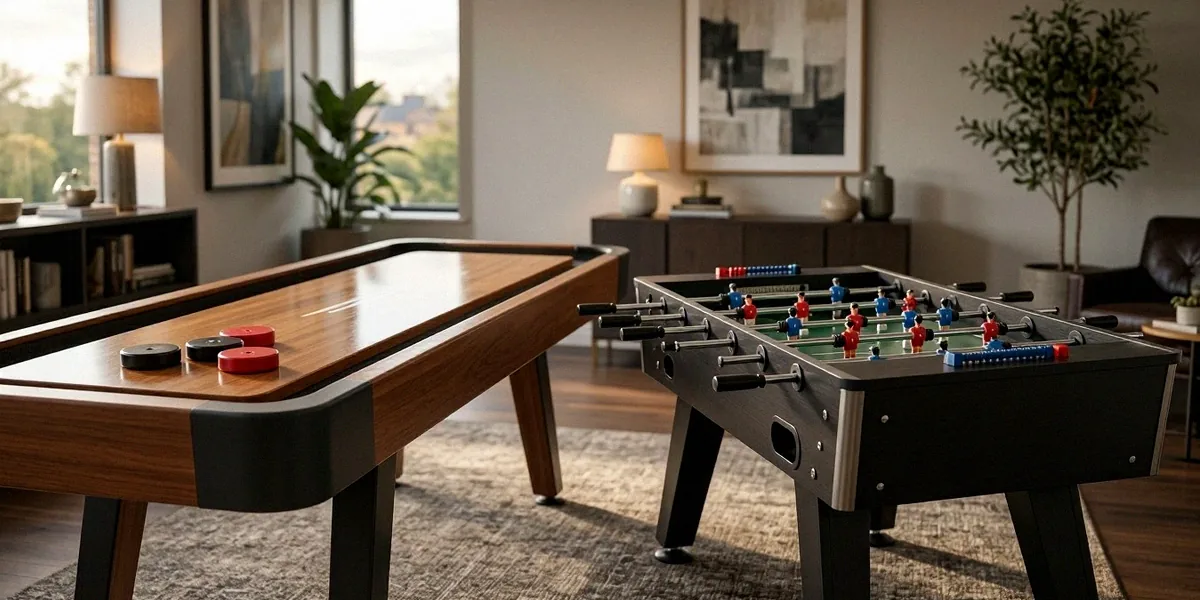
These two games have almost nothing in common except the fact that both end up in pubs, and both end up in someone’s garage by the age of 35. One is a slow, civilised contest with royal connections. The other is a frantic, plastic-and-metal scrap that somehow became a British institution. Let’s look at where each of them actually came from.
Shuffleboard: From Henry VIII’s Court to Your Garage
Shuffleboard originated in Tudor England, where it was played on long wooden tables by the wealthy — and it was apparently such a distraction that Henry VIII banned it. That’s right, the same king who had six wives found time to outlaw a pub game. The ban didn’t stick, obviously. The game evolved, crossed the Atlantic, and came back to the UK as the polished, waxed-table version we know today. There’s something genuinely satisfying about owning a game that annoyed a monarch.
Table Football: A French Toy That Conquered British Pubs
Table football was invented in France in the 1920s, and it made its way into British pubs and youth clubs over the following decades, where it became a staple of the after-work pint. Brands like Garlando and Tornado now dominate the UK market — Garlando tables are everywhere in pubs and family entertainment centres, while Tornado is the name serious players chase for tournament-grade rods and bearings. If you’ve ever played foosball in a Wetherspoons or a holiday park, you’ve played the descendant of a French toy.
Space and Setup: What Fits in a UK Games Room?
Here’s where the romance meets the reality of a British spare bedroom. Most of us are working with something around 2.4m by 3m, low ceilings, and a radiator in the wrong place. Before you buy anything, measure twice and then measure again.
Shuffleboard: The Long Game Needs Length
A standard shuffleboard table is 12ft long. That’s 3.6 metres of solid wood, before you’ve even factored in the standing room at each end. You need at least 2ft of clearance at both ends for a proper slide, which means a shuffleboard realistically needs a room around 5 metres long. Very few UK spare rooms manage that. If you’ve got a converted garage, a long loft, or a dedicated games room, you’re in business. If not, you’re looking at a 9ft table and a compromise on the classic game.
Table Football: Compact but Needs Clearance
A foosball table is around 4ft long — closer to 5ft for a full-size Garlando or Tornado model. That’s a fraction of the footprint. But don’t be fooled into thinking it slots into any gap. You need room to move the rods through their full arc and space for two players to stand side by side at each end. In practice, a foosball table needs a clear rectangle of roughly 2.5m by 1.5m. Most box rooms can manage it; the question is whether you can still open the door once it’s in.
Cost, Build Quality, and Maintenance
This is where the two games really part ways. One is a budget-friendly impulse buy. The other is a proper investment that you’ll either treasure for twenty years or resent for taking up half your house.
Shuffleboard: Investment Pieces and Waxing Woes
Premium shuffleboard tables can cost over £1,000, and that’s before you look at the solid maple or birch models that push £2,000 and beyond. The price reflects the materials — you’re paying for a long, flat, climate-stable playing surface that won’t warp. Maintenance matters too. Shuffleboard tables need regular waxing and silicone spray, and the pucks need rotating so the table wears evenly. Leave it neglected in a cold garage and the wood will let you know about it.
Table Football: From £80 Argos Specials to Pro-Grade Rods
Table football is a far easier sell to the wallet. Argos sells budget foosball tables from around £80, which is enough to get a game going at a house party without anyone crying when a drink gets spilled on it. Step up to a mid-range Garlando or a Roberto Sport table and you’re looking at £300 to £600. A proper Tornado tournament table will set you back £1,000 or more, but the hollow steel rods, counterbalanced men, and laminated cabinet are built for years of abuse. Maintenance is minimal: a wipe down, the occasional drop of oil on the rods, and a new ball now and then.
- Budget foosball (Argos): from around £80 — fine for casual parties, less fine for competitive play.
- Mid-range foosball (Garlando, Roberto Sport): £300–£600 — the sweet spot for most home games rooms.
- Tournament foosball (Tornado): £1,000+ — heavy, fast, and built to last.
- Entry shuffleboard: £400–£700 — usually 9ft, often MDF-cored, perfectly playable.
- Premium shuffleboard: £1,000–£2,500 — solid wood, 12ft, and a genuine piece of furniture.
Gameplay: Skill, Pace, and Party Atmosphere
Both games work at a house party, but they create completely different rooms. One rewards patience and a steady hand. The other rewards reflexes and a total disregard for your own wrists.
Shuffleboard: The Thinking Drinker’s Game
Shuffleboard is slow. Deliberately slow. You slide a puck, you watch it travel, you judge the weight, you plan your next shot around blocking your opponent rather than scoring. It’s a game you can hold a conversation through, which makes it ideal for a relaxed evening with a few friends rather than a full-blown rabble. After three or four beers, your accuracy goes, but the game stays enjoyable — nobody’s going to shout at you for a bad slide. It’s the thinking drinker’s game, and it suits a crowd that likes a bit of strategy with their lager.
Table Football: Fast, Loud, and Perfect for Tournament Nights
Foosball is the opposite. It’s frantic, it’s noisy, and it’s brilliant after a few drinks precisely because chaos is part of the fun. Spin-and-shoot works until someone tells you it’s against the rules, and then it becomes a heated debate. A foosball table turns a house party into a tournament within about twenty minutes, complete with brackets scribbled on the back of a takeaway menu. If you’ve got a competitive group — and every group has one — this is the table that gets used every single week.
Which One Wins for Your UK House Party?
Our honest verdict: it comes down to your space, your crowd, and the kind of night you actually host. A garden party might favour a portable foosball table that can be carried out onto the patio and packed away again. A dedicated games room with a long wall and a solid floor suits shuffleboard beautifully. There’s no universal winner, only the right one for your house.
Choose Shuffleboard If…
- You’ve got a room at least 5 metres long with decent ceiling height.
- You want a piece of furniture that doubles as a talking point.
- Your crowd prefers a slower, more tactical game with drinks in hand.
- You’re happy to wax, clean, and rotate pucks as part of the ritual.
- You’ve got £1,000+ to spend on something that will last decades.
Choose Table Football If…
- Your spare room is small and you need something that fits now.
- You host bigger, louder groups who want a fast, competitive game.
- You want something portable enough for the garden in summer.
- You’d rather spend £80–£600 and keep the rest for the beer fund.
- You want a game that everyone already knows how to play.
The best way to settle this argument is to stop arguing and go and play both. Most UK pubs with a games room have a foosball table, and plenty of social clubs and bars now have shuffleboard too. Spend an evening on each, see which one your mates gravitate towards, and then buy accordingly. Your spare room will thank you for it — and so will Henry VIII, wherever he is.
FAQ
Is shuffleboard or table football better for a small UK games room?
Table football, almost every time. A foosball table is around 4ft long and needs roughly 2.5m by 1.5m of clear space, while a standard shuffleboard table is 12ft long and realistically needs a room around 5 metres. Most British spare bedrooms simply can’t accommodate a full-size shuffleboard, though a 9ft table can work in a longer room.
How much should I expect to spend on a foosball table in the UK?
Argos sells budget foosball tables from around £80, which is fine for casual house parties. Mid-range Garlando and Roberto Sport tables sit between £300 and £600, and a tournament-grade Tornado table will cost £1,000 or more. If you’re playing weekly, the mid-range is the sensible sweet spot.
Do shuffleboard tables really cost over £1,000?
Premium shuffleboard tables can cost over £1,000, and solid wood 12ft models regularly reach £2,000 or more. The price comes down to the length and quality of the playing surface, which needs to stay flat and stable for years. Cheaper 9ft tables with MDF cores start around £400.
Which game is better for a garden party?
Table football is far easier to move outdoors. Many foosball tables are light enough for two people to carry onto a patio, and cheap Argos models are practically designed for it. Shuffleboard tables are heavy, long, and vulnerable to damp, so we’d keep them indoors.
Do you need special maintenance for shuffleboard?
Yes. Shuffleboard tables need regular waxing and silicone spray to keep the puck sliding true, and you should rotate the pucks so the table wears evenly. Table football is much lower maintenance — a wipe down and the occasional drop of oil on the rods is enough.



Post Comment